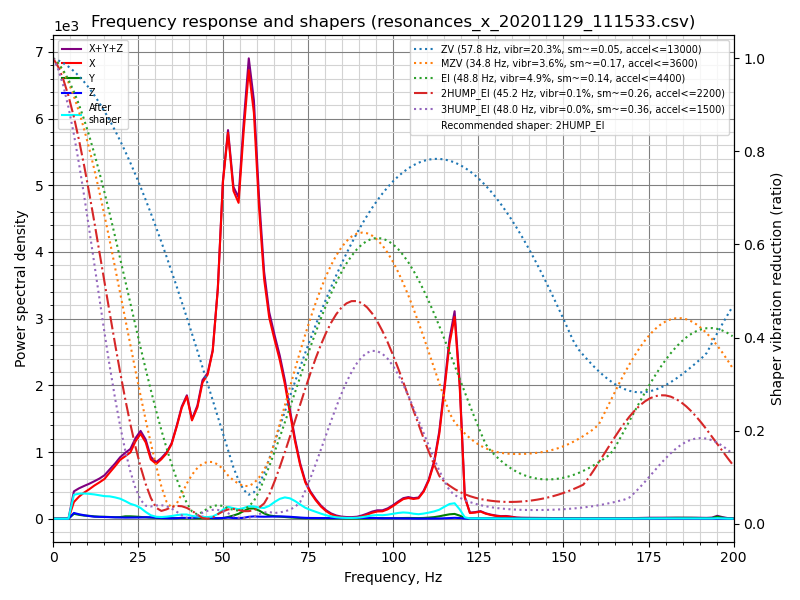
Step 14.14 — Read the graphs¶
Step 14 of 36 with a helper · Chapter 14 — Calibration and tuning
Parts: none.
Do: Generate the PNGs from the CSVs the run left in /tmp. Ran it more than once? Delete the older CSVs first; the script averages every file it matches.
~/klipper/scripts/calibrate_shaper.py /tmp/calibration_data_x_*.csv -o /tmp/shaper_x.png
~/klipper/scripts/calibrate_shaper.py /tmp/calibration_data_y_*.csv -o /tmp/shaper_y.png
 Check
Both plots show a clear dominant peak, and neither axis peaks below 25 Hz.
 Helper Finds the tallest peak on each graph and reads its frequency aloud.
What you're looking at
The chart plots vibration against frequency: the tall peak is the machine's dominant resonance, and the curves show how far each shaper type would suppress it. A plot with no peak at all means the run measured noise rather than the machine.
Read them in this order:
1. Where is the tallest peak? That is the dominant resonance and it is what sets shaper_freq.
2. How many big peaks are there, and how far apart? One clean peak → mzv or zv and a high max_accel. Two or more widely separated peaks → the script will push you to 2hump_ei/3hump_ei, which cost acceleration. Widely separated peaks are usually a mechanical message: a loose backer, an under-tensioned belt, a rail bolt in the end hole.
3. vibrations = X % — residual ringing after shaping. Lower is better; single digits is good.
4. smoothing ~= Y — how much the shaper blurs fine detail. Higher smoothing forces a lower max_accel. The two trade against each other; the script's max_accel line is that trade expressed as a number.
5. Is the plot noise with no peak? Then you measured nothing — go back to MEASURE_AXES_NOISE.
What to expect on a 350, and where the 25 Hz floor comes from
No official per-model figure exists; what is sourced is the floor. Klipper: "If the measured ringing frequency is very low (below approx 20-25 Hz), it might be a good idea to invest into stiffening the printer or decreasing the moving mass… before proceeding with further input shaping tuning."
In practice a well-built 350 with backers fitted lands both axes in roughly the 35–60 Hz band, X usually the higher of the two — the toolhead alone is lighter than the whole gantry that Y has to move. Treat that band as community-observed, not a spec.
Caution
Below 25 Hz on either axis is a build fault, not a tuning result. Stop, and go re-check belt tension, the titanium backers, the XY joints and the frame bolts before you shape over it.
Source: Klipper docs/img/calibrate-x.png · Klipper docs § Resonance compensation · Klipper docs § Max smoothing