Step 14.4 — Set A/B belt tension to 110 Hz over a 150 mm span¶
Step 4 of 36 with a helper · Chapter 14 — Calibration and tuning
 Gather for this segment — step 14.4 (~20 min)
Tools and consumables
- 2.5 mm hex key
- steel rule
- phone with a spectrum analyser app
Already on the bench
- the two M3×40 A/B front-idler tensioner screws
Parts:
- the two M3×40 A/B front-idler tensioner screws · already on the bench
- 2.5 mm hex key · tool
- steel rule · tool
- phone with a spectrum analyser app · tool
Do:
- Cold or cooling, panels on, door open:
SET_IDLE_TIMEOUT TIMEOUT=99999,G28, gantry mid-height,SET_STEPPER_ENABLE STEPPER=stepper_x ENABLE=0andSTEPPER=stepper_y. - Set a measured 150 mm span between the idler centres, pluck A, read the lowest peak, tension to 110 Hz, repeat on B until equal.
 Check
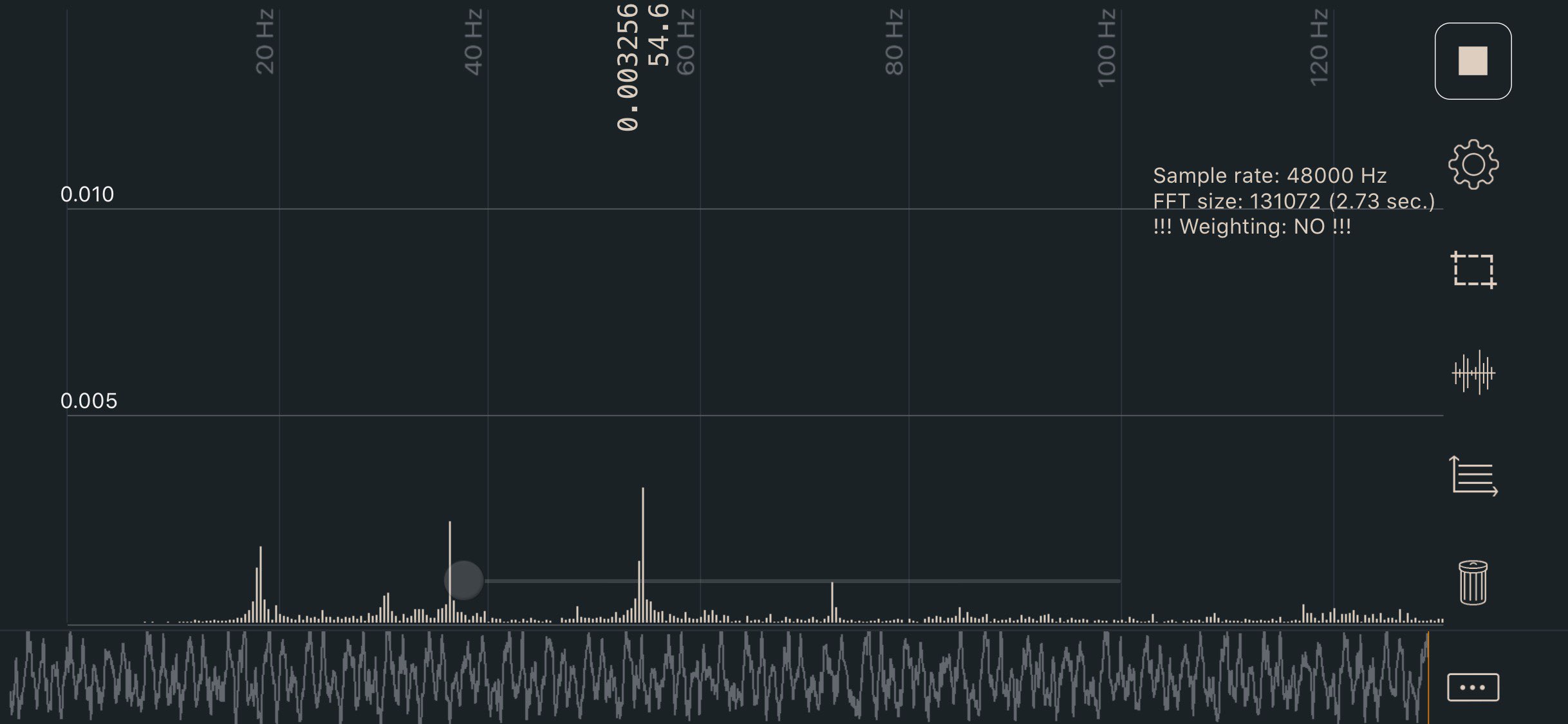
A and B agree within a few Hz at ~110 Hz after moving the gantry and returning. Write both in the tuning log.
 Helper Holds the phone by the span and reads the lowest peak aloud after each pluck.
What you're looking at
These three steps are the end of Voron's gantry-squaring procedure, split off from Ch 06b because they need a closed chamber. Prerequisites: Ch 06b cold squaring done (Checkpoint 06b ticked, Z joint M5×40 bolts still at their light 06b.13 torque, A/B belts at the provisional tension 06b set) and Ch 11 Part B panels and door on. Ch 14 owns final belt tension: 14.4 sets A/B, 14.5 sets Z, 14.6 soaks the closed machine, settles QGL and locks the Z joints hot. Voron's order — tension first (its step 13), then soak, QGL and the hot tighten (14–17) — is kept, because tightening the joints hot freezes the gantry's geometry and re-tensioning afterwards would move what was just frozen.
The photo shows a phone spectrum analyser on a plucked belt. A tensioned belt is a string: its lowest frequency peak is its pitch. A frequency means nothing without its span. Ch 06b put a working tension on these belts; this is the final one.
Caution
If one reads 110 and the other 95, the gantry is not square — go back to Ch 06b, do not compensate with tension.
Caution
Never M84 on this machine with the gantry in the air: it releases the Z motors too and the gantry drops onto the bed. Disable only stepper_x and stepper_y, so the X carriage moves by hand while the four Z motors hold the gantry.
 Tip
the two tensions affect each other, so go back and forth until both are equal. Move the X extrusion back a few centimetres and forward again, then re-check both.
Why 110 Hz over a 150 mm span — the three sources disagree
| Source | A/B target | Z target |
|---|---|---|
| Official assembly manual p.125 | no number — "cut both belts to the same length" | no number |
| docs.vorondesign.com — Secondary Printer Tuning | 110 Hz over a 150 mm span (≈ 2 lb, "on the lower end of the range") | 140 Hz over 150 mm |
| voronldo.com belt tension guide | 80–100 Hz for a 350 | "same as X/Y, 110–130 Hz" |
Use 110 Hz / 150 mm. It is the only sourced official figure, and it is the only one that names the span, which is what makes a frequency mean anything — the same belt at a 200 mm span reads far lower. The Voron docs also explain why 110: it corresponds to roughly 2 lb of tension and is deliberately at the low end, so you get a good starting point without stretching the belts. The survey rejects voronldo.com as unaffiliated, uncited and internally inconsistent (survey §4.3, §9 Rejected sources) — ignore the 80–100 Hz figure entirely.
 Good stopping point · ~20 min since the last one
A and B are both at final tension and equal. Belts are a single calibration item: never stop with one of the pair adjusted and the other not. Leave the gantry parked mid-travel with the Z motors holding and the idle timeout still raised; Step 14.6 puts it back to 1800 at the end, once the last hot check has passed.
Source: Voron docs image sound-spectrum-belt.jpg · Voron docs — Secondary printer tuning § Belt tension · Voron manual p.125 · Klipper docs § SET_IDLE_TIMEOUT · Ch 06b Steps 06b.1, 06b.5